The MikroTik RouterOS supports the PrismII chipset based wireless adapter cards for working both as wireless clients (station mode) and wireless access points (ap-bridge or bridge mode). See the list of supported Pirsm II chipset based hardware at the end of the document.
Both PCI and PCMCIA card types are supported.
For more information about adapter hardware please see the relevant
User’s Guides and Technical Reference Manuals of the hardware manufacturers.
Check Notes on PCMCIA Adapters for more information on PCMCIA adapters.
An Additional Feature License is required to enable your Access Point feature. The Wireless Client License is required as well. AP mode can be enabled only for these cards:
IEEE 802.11b 2.4GHz 11Mbps Prism II, Prism 2.5 Cards
IEEE 802.11a 5.2GHz 54Mbps Atheros Cards
The PrismII Access Point interface can register other access points. Thus, it is possible to bridge networks over wireless links.
Important! Prism 2.5 200mW cards require firmware 1.3.6 or lower, if you want to bridge networks. Please see the troubleshooting section on how to check the firmware version and downgrade it.
Installation
The MikroTik Router should have the prism software package installed.
The software package file prism-2.6.x.npk can be downloaded from
MikroTik’s web page www.mikrotik.com.
To install the package, please upload the correct version file to the router and reboot.
Use BINARY mode ftp transfer.
After successful installation the package should be listed under the installed
software packages list.
Note! The 2.4GHz Wireless Feature License enables only the
station or bridge mode of the Prism II card.
To enable the ap-bridge mode, additionally the Wireless AP Feature
License is required.
The MikroTik RouterOS supports as many PrismII chipset based cards as many free resources are on your system, i.e., IRQs and adapter slots, but not more than 6. One license is valid for all cards on your system.
[admin@MikroTik] > system resource irq print
Flags: U - unused
   IRQ OWNER
   1   keyboard
   2   APIC
 U 3
   4   serial port
 U 5
 U 6
 U 7
 U 8
   9   ether1
 U 10
   11  PCMCIA service
   11  [prism2_cs]
 U 12
 U 13
   14  IDE 1
[admin@MikroTik] > system resource io print
 PORT-RANGE        OWNER
 20-3F             APIC
 40-5F             timer
 60-6F             keyboard
 80-8F             DMA
 A0-BF             APIC
 C0-DF             DMA
 F0-FF             FPU
 100-13F           [prism2_cs]
 1F0-1F7           IDE 1
 2F8-2FF           serial port
 3C0-3DF           VGA
 3F6-3F6           IDE 1
 3F8-3FF           serial port
 CF8-CFF           [PCI conf1]
 EF00-EFFF         [Realtek Semiconductor Co., Ltd. RTL-8139]
 EF00-EFFF         [8139too]
 FC00-FC7F         [Cyrix Corporation 5530 IDE [Kahlua]]
 FC00-FC07         IDE 1
 FC08-FC0F         IDE 2
[MikroTik] >
There can be several reasons for a failure to load the driver, for example:
Usually two consecutive beeps of high tone can be heard during the startup of the MikroTik RouterOS router with PCMCIA PrismII card. If the second beep has a lower tone, or there is only one lower tone beep, most likely there is a compatibility problem with the motherboard. Try to use another type of motherboard.
Wireless Interface Configuration
If the driver has been loaded successfully, and you have the
required 2.4GHz Wireless Software License, then the Prism II 2.4GHz Wireless
interface should appear under the /interface list with the name prismX, where X is 1,2,...
You can change the interface name to a more descriptive one using the set command.
To enable the interface, use the enable command:
[admin@MikroTik] > interface print
Flags: X - disabled, D - dynamic, R - running
  #    NAME                 TYPE             MTU
  0  R ether1               ether            1500
  1 X  prism1               prism            1500
[admin@MikroTik] > interface enable 1
[admin@MikroTik] > interface print
Flags: X - disabled, D - dynamic, R - running
  #    NAME                 TYPE             MTU
  0  R ether1               ether            1500
  1    prism1               prism            1500
[admin@MikroTik] >
More configuration and statistics parameters can be found under the /interface prism menu:
[admin@MikroTik] interface prism> print
Flags: X - disabled, R - running
  0    name="prism1" mtu=1500 mac-address=00:90:4B:02:17:E2 arp=enabled
       mode=station root-ap=00:00:00:00:00:00 frequency=2412MHz ssid="mikrotik"
       default-authentication=yes default-forwarding=yes max-clients=2007
       card-type=generic tx-power=auto supported-rates=1-11 basic-rates=1

[admin@MikroTik] interface prism>
Argument description:
name - Interface name (same as for other interfaces)
mtu - Maximum transfer unit (same as for other interfaces)
mac-address - MAC address of card. In AP mode this will also be BSSID of BSS.
arp - Address Resolution Protocol, one of the:mode - Mode of the interface:
- disabled - the interface will not use ARP protocol
- enabled - the interface will use ARP protocol
- proxy-arp - the interface will be an ARP proxy (see corresponding manual)
- reply-only - the interface will only reply to the requests originated to its own IP addresses, but neighbour MAC addresses will be gathered from /ip arp statically set table only.
root-ap - (only ap-bridge or bridge) MAC address of the root access point to register to.
- station, card works as station (client) for the wireless infrastructure)
- bridge, card works as access point, but can register only one client or access point
- ap-bridge, card works as access point, i.e., it creates wireless infrastructure
frequency - (only ap-bridge or bridge) Frequency that AP will use to create BSS
ssid - Service Set Identifier. In station mode - ssid to connect to, in AP and P2P mode - ssid to use when creating BSS (this can not be left blank).
default-authentication - (only ap-bridge or bridge) What to do with client that wants to associate, but it is not in the access-list.
default-forwarding - (only ap-bridge or bridge) What to do with client that wants to send packets to other wireless clients, but it is not in the access-list.
max-clients - (only ap-bridge or bridge) Maximum number of clients (including other access points), that is allowed to associate with this access point (1...2007).
card-type - Card type used for power settings (100mW, 200mW, 30mW, generic, default is generic)
tx-power - Transmit power level (0dBm-1mW...23dBm-200mW / auto). Has no effect if card type is generic. auto means default setting of the card.
supported-rates - Rates at which this node will work.
basic-rates - (only ap-bridge or bridge) Rates that every client that plans to connect to this AP should be able to work at. It is recommended to set it to 1, since not all clients might support rates 1-11.
Station Mode Configuration
To set the wireless interface for working with an IEEE 802.11b access point (register to the AP),
you should set the following parameters:
[admin@MikroTik] interface prism> set prism1 ssid=testing
[admin@MikroTik] interface prism> enable prism1
[admin@MikroTik] interface prism> print
Flags: X - disabled, R - running
  0    name="prism1" mtu=1500 mac-address=00:90:4B:02:17:E2 arp=enabled
       mode=station root-ap=00:00:00:00:00:00 frequency=2412MHz ssid="testing"
       default-authentication=yes default-forwarding=yes max-clients=2007
       card-type=generic tx-power=auto supported-rates=1-11 basic-rates=1

[admin@MikroTik] interface prism>
Note for CISCO/Aironet Wireless Bridge and Access Point users
When working with Prism II chipset based clients, the CISCO/Aironet Wireless Bridge or AP should have the following settings:
- the Proprietary Extensions should be turned 'off' under Configuration/Radio/802.11 menu
- the Encapsulation Protocol should be RFC1042 under Configuration/Radio/802.11/Encapsulation menu
In station mode, the prism interface status can be monitored using the /interface prism monitor command:
[admin@MikroTik] interface prism> monitor 0
                      status: connected-to-ess
                   data-rate: 11Mbps
                        ssid: "testing"
                       bssid: 00:03:2F:04:25:10
              signal-quality: 92
                signal-level: 54
                 noise-level: -99

[admin@MikroTik] interface prism>
Argument description:
status - status of the interface
data-rate - the actual data rate of the connection.
- searching-for-network - the card has not registered to an AP and is searching for one to register to
- connected-to-ess - the card has registered to an AP
- out-of-range - the card has registered to an AP, but lost the connection to it.
ssid - the Service Set Identifier.
bssid - the Basic Service Set Identifier (actually, the MAC address of the access point).
signal-quality - the signal quality (0-92).
signal-level - the average signal level (27-154).
noise-level - the average noise level (-100-0).
The monitor command does not work, if the interface is disabled, or the mode is ap-bridge or bridge.
Access Point Mode Configuration
To set the wireless interface for working as an IEEE 802.11b access point (register clients),
you need both the 2.4GHz Wireless Feature License and the Prism AP Feature Licenses.
You should set the following parameters:
All other parameters can be left as default. However, you should make sure, that all clients support the basic rate of your access point, i.e., the supported-rates of the client should cove the basic-rates of the access point.
To configure the wireless interface for working as an access point with ssid "testing" and use the frequency 2442MHz, it is enough to enter the command:
[admin@MikroTik] interface prism> set prism1 mode=ap-bridge frequency=2442 ssid=testing
[admin@MikroTik] interface prism> print
Flags: X - disabled, R - running
  0  R name="prism1" mtu=1500 mac-address=00:90:4B:02:17:E2 arp=enabled
       mode=ap-bridge root-ap=00:00:00:00:00:00 frequency=2442MHz ssid="testing"
       default-authentication=yes default-forwarding=yes max-clients=2007
       card-type=generic tx-power=auto supported-rates=1-11 basic-rates=1

[admin@MikroTik] interface prism>
Use the registration table to see the associated clients.
[admin@MikroTik] interface prism> registration-table print
  # INTERFACE                     MAC-ADDRESS       TYPE      PARENT
  0 prism1                        00:07:EB:30:E7:DA client
  1 prism1                        00:40:96:29:2F:80 client
[admin@MikroTik] interface prism>
Argument description for the registration-table entry:
interface - interface that client is registered to
mac-address - mac address of the registered client
type - type of the client:
parent - parent access point's MAC address, if forwarded from another access point
- client - client registered to the interface
- local - client learned from bridged interface
- ap - client is an access point
- forward - client is forwarded from another access point
- parent-ap - the access point this interface is connected to
The print stats or print detail commands give additional per-client statistics:
[admin@MikroTik] interface prism> registration-table print stats
  0 interface=prism1 mac-address=00:07:EB:30:E7:DA type=client packets=0,19
    bytes=0,482 signal-level=69/75/138 noise-level=0/0/0 data-rate=10/110/110
    tx-rate=10 last-update=00:00:00.840 uptime=00:02:59.180

  1 interface=prism1 mac-address=00:40:96:29:2F:80 type=client packets=0,14
    bytes=0,196 signal-level=66/72/84 noise-level=0/0/0 data-rate=10/10/10
    tx-rate=10 last-update=00:00:08.380 uptime=00:02:42.220


[admin@MikroTik] interface prism>
Additional argument description (only for wireless clients):
packets - number of received and sent packets
bytes - number of received and sent bytes
signal-level - min/average/max signal level
noise-level - min/average/max noise level
data-rate - min/average/max receive data rate
tx-rate - transmit data rate
last-update - time since the last update
uptime - time the client is associated with the access point
The association procedure is as follows: when a new client wants to associate to the AP that is configured on interface prismX, entry with client's MAC address and interface prismX is looked up in the access-list. If such entry is found, action specified in it is taken. Otherwise default-authentication and default-forwarding of interface prismX is taken.
To add an access list entry, use the add command, for example:
[admin@MikroTik] interface prism access-list> add mac-address=00:40:96:37:A3:39
interface=prism1
[admin@MikroTik] interface prism access-list> print
Flags: X - disabled, I - invalid
  0   mac-address=00:40:96:37:A3:39 interface=prism1 authentication=yes
      forwarding=yes

[admin@MikroTik] interface prism access-list>
Argument description:
mac-address - MAC address of the client
interface - AP interface
authentication - accept this client when it tries to connect or not
forwarding - forward the client's frames to other wireless clients or not
If you have default authentication action for the interface set to yes, you can disallow this node to register at the AP's interface 'prism1' by setting authentication=no for it. Thus, all nodes except this one will be able to register to the interface 'prism1'.
If you have default authentication action for the interface set to no, you can allow this node to register at the AP's interface 'prism1' by setting authentication=yes for it. Thus, only the specified nodes will be able to register to the interface 'prism1'.
You can configure the access point to registering to another (root) access point by specifying the MAC address of the root access point:
[admin@MikroTik] interface prism> set prism1 root-ap=00:90:4B:03:F1:71
[admin@MikroTik] interface prism> print
Flags: X - disabled, R - running
  0  R name="prism1" mtu=1500 mac-address=00:90:4B:02:17:E2 arp=enabled
       mode=ap-bridge root-ap=00:90:4B:03:F1:71 frequency=2442MHz ssid="testing"
       default-authentication=yes default-forwarding=yes max-clients=2007
       card-type=generic tx-power=auto supported-rates=1-11 basic-rates=1


[admin@MikroTik] interface prism>
The 'non-root' access point will register the clients only if it is registered to the 'root' access point.
Having one access point registered to another one enables bridging the networks, if bridging mode between prism and ethernet interfaces is used. Note, that in the station mode, bridging cannot be used between prism and ethernet interfaces.
Important! Prism 2.5 200mW cards require firmware 1.3.6 or lower, if you want to bridge networks. Please see the troubleshooting section on how to check the firmware version and downgrade it.
The prism interface has feature that allows scanning for available networks.
While scanning, the card unregisters itself from the access point (in station mode),
or unregisters all clients (in bridge or ap-bridge mode). Thus, network connections are
lost while scanning.
Use the /interface prism scan command to scan for available networks, for example:
Argument description:
The result of scanning contains a list of discovered access points along
with their MAC addresses, channel frequencies, service set identificators, and the
measured signal level.
The prism interface status changes can be logged locally or to a remote syslog daemon
by enabling the logging facility, for example:
The local logs can be viewed using the /log print command.
Network Scan
[admin@MikroTik] interface prism> scan
Scan for wireless networks
  <interface>
  frequencies  List of frequencies to scan
         time  Time to scan one frequency
[admin@MikroTik] interface prism> scan prism1
00:02:6f:01:5d:fe fequency=2412MHz ssid=waubonsie_low_ap1 signal-level=132
00:02:6f:01:63:0b fequency=2427MHz ssid=john signal-level=114
00:02:6f:01:62:ee fequency=2462MHz ssid=sales signal-level=0
[admin@MikroTik] interface prism>
<interface> - interface name to use for scanning
frequencies - list of frequencies to scan for, e.g., 2412MHz,2427MHz
time - time to scan for one frequency. The total time used for scanning
is multiplier of this value and the number of frequencies to scan.
[admin@MikroTik] system logging facility> set Prism-Info logging=local
[admin@MikroTik] system logging facility> print
  # FACILITY            LOGGING PREFIX              REMOTE-ADDRESS  REMOTE-PORT
  0 Firewall-Log        none
  1 PPP-Account         none
  2 PPP-Info            none
  3 PPP-Error           none
  4 System-Info         local
  5 System-Error        local
  6 System-Warning      local
  7 Prism-Info          local
[admin@MikroTik] system logging facility>
Obtain the required license for 2.4GHz wireless feature.
Set some parameter of the prism interface to get all nodes re-register.
Prism 2.5 200mW cards require firmware 1.3.6 or lower, if you want to bridge networks.
Firmware can be downgraded by installing the card in a Windows computer,
and running the firmware upgrade utility FRMUPDATE25.EXE from
2511cd_frm306.zip
Check the cabling and antenna alignment.
Wireless Network Applications
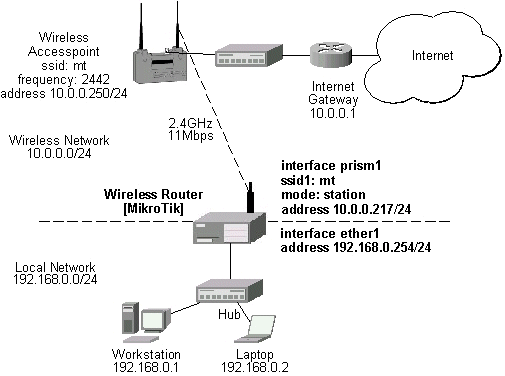
Three possible wireless network configurations are discussed in the following examples:
The access point is connected to the wired network's HUB and has IP address from the network 10.0.0.0/24. The minimum configuration required for the AP is:
Note! Please note, that the AP is not a router! It has just one network address, and is just like any host on the network. It resembles a wireless-to-Ethernet HUB or bridge. The AP does not route the IP traffic!
The minimum configuration for the MikroTik router's prism wireless interface is:
[admin@MikroTik] interface prism> set 0 ssid=mt
[admin@MikroTik] interface prism> monitor 0
                      status: connected-to-ess
                   data-rate: 11Mbps
                        ssid: "mt"
                       bssid: 00:40:96:56:E2:AD
              signal-quality: 78
                signal-level: 125
                 noise-level: -99

[admin@MikroTik] interface prism>
The IP addresses assigned to the wireless interface should be from the network 10.0.0.0/24, e.g.:
[admin@MikroTik] ip address> add address=10.0.0.217/24 interface=prism1
[admin@MikroTik] ip address> print
Flags: X - disabled, I - invalid, D - dynamic
  #   ADDRESS            NETWORK         BROADCAST       INTERFACE
  0   10.0.0.217/24      10.0.0.0        10.0.0.255      prism1
  1   192.168.0.254/24   192.168.0.254   192.168.0.254   ether1
[MikroTik] ip address>
The default route should be set to the gateway router 10.0.0.1 (not to the AP 10.1.1.250 !):
[admin@MikroTik] ip route> add gateway=10.0.0.1
[admin@MikroTik] ip route> print
Flags: X - disabled, I - invalid, D - dynamic, J - rejected,
C - connect, S - static, R - rip, O - ospf, B - bgp
    #    DST-ADDRESS        G GATEWAY         DISTANCE INTERFACE
    0  S 0.0.0.0/0          r 10.0.0.1        1        prism1
    1 DC 10.0.0.0/24        r 0.0.0.0         0        prism1
    2 DC 192.168.0.0/24     r 0.0.0.0         0        ether1
[admin@MikroTik] interface prism>
Note! You cannot use the bridging function between the prism and ethernet interfaces, if the prism interface is in the station mode. The bridge does not work in this case!
You need both the 2.4GHz Wireless and the Prism AP Feature Licenses to enable the AP mode.
To make the MikroTik router work as an access point,
the configuration of the prism wireless interface should be as follows:
The list of registered clients looks like follows:
There are two possible ways of implementing the wireless access point feature:
The client router requires the System Service Identificator set to "mt".
The IP addresses assigned to the interfaces should be from networks
10.0.0.0/24 and 192.168.0.0./24:
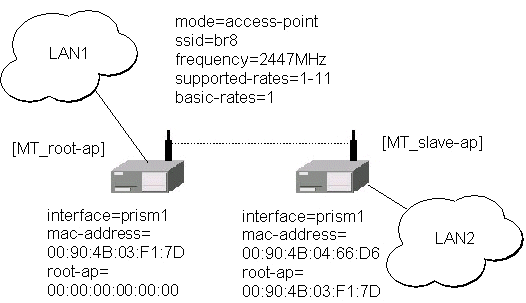
To set up a wireless bridge between two networks,
you need to have a "wireless 2.4GHz" or "AP" license.
Configure one MikroTik RouterOS Prism AP to register to another
MikroTik RouterOS Prism AP for point-to-point operation.
The basic setup is as follows:
Below are step-by-step configurations for both units. The system identities
are set to [MT-parent] and [MT-child], respectively.
Here, substitute the xx:xx:xx:xx:xx:xx with MAC address of [MT-parent] prism interface.
Note, that both LANs should use IP addresses from the same network 10.0.0.0/24.
Both MikroTik routers belong to the same network too.
You should be able to ping through the wireless bridge from one LAN to other
and to gateway 10.0.0.1.
Many wireless cards based on the Prism 2 and above chipset use the prism
reference design PCI identifier or PCI identifier of the OEM producer of the card.
They do not have a unique identifier based on the brand name or company name on the PCI card.
So, for many cards, it is needed to simply test and see if it is recognized.
MikroTik RouterOS supports the following PCI identifiers for the Prism 2
and above chipset based hardware:
Wireless Access Point
Let us consider the following point-to-point wireless network setup with two MikroTik Wireless Routers:
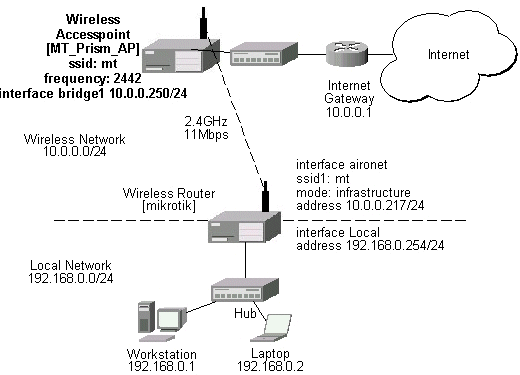
The following command should be issued to change the settings for the prism interface:
[admin@MT_Prism_AP] interface prism> set 0 mode=ap-bridge frequency=2442MHz ssid=mt
[admin@MT_Prism_AP] interface prism> print
Flags: X - disabled, R - running
  0  R name="prism1" mtu=1500 mac-address=00:90:4B:02:17:E2 arp=enabled
       mode=ap-bridge root-ap=00:00:00:00:00:00 frequency=2442MHz ssid="mt"
       default-authentication=yes default-forwarding=yes max-clients=2007
       card-type=generic tx-power=auto supported-rates=1-11 basic-rates=1

[admin@MT_Prism_AP] interface prism> monitor 0
           current-sta-count: 2
            current-ap-count: 0
         current-local-count: 0
    current-forwarding-count: 0

[admin@MT_Prism_AP] interface prism>
[admin@MT_Prism_AP] interface prism> registration-table print
  # INTERFACE                     MAC-ADDRESS       TYPE      PARENT
  0 prism1                        00:07:EB:30:E7:DA client
  1 prism1                        00:02:6F:01:5D:FE client
[admin@MT_Prism_AP] interface prism>
To enable bridging between the ethernet and prism interfaces, do the following:
[admin@MT_Prism_AP] interface bridge> add forward-protocols=ip,arp,other
[admin@MT_Prism_AP] interface bridge> print
Flags: X - disabled, R - running
  0 X  name="bridge1" mtu=1500 arp=enabled mac-address=00:00:00:00:00:00
       forward-protocols=ip,arp,other priority=1

[admin@MT_Prism_AP] interface bridge>
[admin@MT_Prism_AP] interface bridge port> set "ether1,prism1" bridge=bridge1
[admin@MT_Prism_AP] interface bridge port> print
Flags: X - disabled
  #   INTERFACE                            BRIDGE
  0   ether1                               bridge1
  1   prism1                               bridge1
[admin@MT_Prism_AP] interface bridge port>
[admin@MT_Prism_AP] interface> print
Flags: X - disabled, D - dynamic, R - running
  #    NAME                 TYPE             MTU
  0  R ether1               ether            1500
  1  R prism1               prism            1500
  2 X  bridge1              bridge           1500
[admin@MT_Prism_AP] interface> enable bridge1
[admin@MT_Prism_AP] interface> print
Flags: X - disabled, D - dynamic, R - running
  #    NAME                 TYPE             MTU
  0  R ether1               ether            1500
  1  R prism1               prism            1500
  2  R  bridge1              bridge           1500
[admin@MT_Prism_AP] interface>
[admin@MT_Prism_AP] ip address> add address=10.0.0.250/24 interface=bridge1
[admin@MT_Prism_AP] ip address> print
Flags: X - disabled, I - invalid, D - dynamic
  #   ADDRESS            NETWORK         BROADCAST       INTERFACE
  0   10.0.0.250/24      10.0.0.0        10.0.0.255      bridge1
[admin@MT_Prism_AP] ip address> .. route add gateway=10.0.0.1
[admin@MT_Prism_AP] ip address> .. route print
Flags: X - disabled, I - invalid, D - dynamic, J - rejected,
C - connect, S - static, R - rip, O - ospf, B - bgp
    #    DST-ADDRESS        G GATEWAY         DISTANCE INTERFACE
    0  S 0.0.0.0/0          r 10.0.0.1        1        bridge1
    1 DC 10.0.0.0/24        r 0.0.0.0         0        bridge1
[admin@MT_Prism_AP] ip address>
[admin@mikrotik] ip address> print
Flags: X - disabled, I - invalid, D - dynamic
  #   ADDRESS            NETWORK         BROADCAST       INTERFACE
  0   10.0.0.217/24      10.0.0.0        10.0.0.255      aironet
  1   192.168.0.254/24   192.168.0.0     192.168.0.255   Local
[admin@mikrotik] ip address>
The default route should be set to gateway 10.0.0.1 for the router [mikrotik]:
[admin@mikrotik] ip route> add gateway=10.0.0.254
[admin@mikrotik] ip route> print
Flags: X - disabled, I - invalid, D - dynamic, J - rejected,
C - connect, S - static, R - rip, O - ospf, B - bgp
    #    DST-ADDRESS        G GATEWAY         DISTANCE INTERFACE
    0  S 0.0.0.0/0          r 10.0.0.1        1        aironet
    1 DC 10.0.0.0/24        r 0.0.0.0         0        aironet
    2 DC 192.168.0.254/24   r 0.0.0.0         0        Local
[admin@mikrotik] ip route>
Wireless Bridge
Important! Prism 2.5 200mW cards require firmware 1.3.6 or lower,
if you want to bridge networks. Please see the troubleshooting section on how to check
the firmware version and downgrade it.
[MT-parent] Configuration
Assume you have interfaces ether1 and prism1 under /interface list.
/interface enable ether1
Set mode=bridge, ssid=br8, frequency=2447MHz,
and enable prism1 interface (you can use mode=ap-bridge, if you have Prism AP License):
/interface prism set prism1 mode=bridge ssid=br8 frequency=2447 disabled=no
/interface bridge add forward-protocols=ip,arp,other disabled=no
/interface bridge port set ether1,prism1 bridge=bridge1
/ip address add address=10.0.0.217/24 interface=bridge1
/ip route add gw=10.0.0.1
[MT-child] Configuration
Assume you have interfaces ether1 and prism1 under /interface list.
/interface enable ether1
Here, you have to specify root-ap MAC address,
so the Prism radio registers to the root AP.
Set mode=bridge, ssid=br8, frequency=2447MHz,
root-ap=xx:xx:xx:xx:xx:xx, and enable prism1 interface
(you can use mode=ap-bridge, if you have Prism AP License):
/interface prism set prism1 mode=bridge ssid=br8 frequency=2447 \
root-ap=xx:xx:xx:xx:xx:xx disabled=no
[admin@MT-child] interface prism> registration-table print
  # INTERFACE                     MAC-ADDRESS       TYPE      PARENT
  0 prism1                        00:02:6F:01:CE:2A parent-ap
[admin@MikroTik] interface prism>
/interface bridge add forward-protocols=ip,arp,other disabled=no
/interface bridge port set ether1,prism1 bridge=bridge1
/ip address add address=10.0.0.218/24 interface=bridge1
/ip route add gw=10.0.0.1
card "Intersil PRISM2 Reference Design 11Mb/s 802.11b WLAN Card"
   version "INTERSIL", "HFA384x/IEEE"

card "GemTek WL-211 Wireless LAN PC Card"
   version "Wireless LAN", "11Mbps PC Card"

card "Compaq WL100/200 11Mb/s 802.11b WLzAN Card"
   manfid 0x0138, 0x0002

card "Compaq iPaq HNW-100 11Mb/s 802.11b WLAN Card"
   manfid 0x028a, 0x0002

card "Samsung SWL2000-N 11Mb/s 802.11b WLAN Card"
   manfid 0x0250, 0x0002

card "Z-Com XI300 11Mb/s 802.11b WLAN Card"
   manfid 0xd601, 0x0002

card "ZoomAir 4100 11Mb/s 802.11b WLAN Card"
   version "ZoomAir 11Mbps High", "Rate wireless Networking"

card "Linksys WPC11 11Mbps 802.11b WLAN Card"
   version "Instant Wireless ", " Network PC CARD", "Version 01.02"

card "Addtron AWP-100 11Mbps 802.11b WLAN Card"
   version "Addtron", "AWP-100 Wireless PCMCIA", "Version 01.02"

card "D-Link DWL-650 11Mbps 802.11b WLAN Card"
   version "D", "Link DWL-650 11Mbps WLAN Card", "Version 01.02"

card "SMC 2632W 11Mbps 802.11b WLAN Card"
   version "SMC", "SMC2632W", "Version 01.02"

card "BroMax Freeport 11Mbps 802.11b WLAN Card"
  version "Intersil", "PRISM 2_5 PCMCIA ADAPTER", "ISL37300P", "Eval-RevA"

card "Intersil PRISM2 Reference Design 11Mb/s WLAN Card"
   manfid 0x0156, 0x0002

card "Bromax OEM 11Mbps 802.11b WLAN Card (Prism 2.5)"
   manfid 0x0274, 0x1612

card "Bromax OEM 11Mbps 802.11b WLAN Card (Prism 3)"
   manfid 0x0274, 0x1613

card "corega K.K. Wireless LAN PCC-11"
   version "corega K.K.", "Wireless LAN PCC-11"

card "corega K.K. Wireless LAN PCCA-11"
   version "corega K.K.", "Wireless LAN PCCA-11"

card "CONTEC FLEXSCAN/FX-DDS110-PCC"
   manfid 0xc001, 0x0008

card "PLANEX GeoWave/GW-NS110"
   version "PLANEX", "GeoWave/GW-NS110"

card "Ambicom WL1100 11Mbps 802.11b WLAN Card"
   version "OEM", "PRISM2 IEEE 802.11 PC-Card", "Version 01.02"

card "LeArtery SYNCBYAIR 11Mbps 802.11b WLAN Card"
   version "LeArtery", "SYNCBYAIR 11Mbps Wireless LAN PC Card", "Version 01.02"

card "Intermec MobileLAN 11Mbps 802.11b WLAN Card"
   manfid 0x01ff, 0x0008

card "NETGEAR MA401 11Mbps 802.11 WLAN Card"
   version "NETGEAR MA401 Wireless PC", "Card", "Version 01.00"

card "Intersil PRISM Freedom 11mbps 802.11 WLAN Card"
   version "Intersil", "PRISM Freedom PCMCIA Adapter", "ISL37100P", "Eval-RevA"

card "OTC Wireless AirEZY 2411-PCC 11Mbps 802.11 WLAN Card"
   version "OTC", "Wireless AirEZY 2411-PCC WLAN Card", "Version 01.02"

card "Zcomax XI-325HP PCMCIA 200mW Card"
© Copyright 1999-2003, MikroTik